Read along to the podcast:
Kathi Lipp:
Welcome to Clutter-Free-Academy where our goal is to help you take small doable steps to live every day with less clutter and more life. Joining me today is my co-author on our new book “You Don’t Have to Try So Hard,” Cheri Gregory. Cheri welcome back for the final and fourth time this month to Clutter-Free-Academy!
Cheri Gregory:
Thank you!
Kathi:
We’re talking about perfectionism, and since you and I have overcome perfectionism perfectly, this will be actually a very fun one to talk about. This is the fourth of our four bullies that we talked about in “You Don’t Have to Try So Hard,” the things that keep us from doing the things that God has created us to do. I’m excited to jump in! We’ve got a little quiz on how to know if you’re a perfectionist:
Number one: When people cannot resist the urge to correct other peoples’ grammar without being asked.
Cheri:
Why does this bug you so much?
Kathi:
Because everybody does it to me. People are mean!
Cheri: It is so impertinent! I don’t think I’ve ever done it to you.
Kathi:
I don’t think you have either. I know you have come to me and said I’ve got a word in my post that I didn’t mean to, and by the way, my posts are getting much better. One way that people can come to you to say this is like, “Oh my goodness Kathi, I just saw your post and I loved it! I don’t know if you noticed there’s this one word that kind of changes the meaning of stuff, and if you’re fine with it, it I’m fine with it. But I just wanted you to be able to see that.” Because here’s the thing, I do have dyslexia. I don’t see it. Sometimes it is funny. But when the person who points it out is laughing and pointing it out just to say I’m an idiot, I’m not cool with that.
Cheri:
I think we see this in so many aspects where the only thing the person could think to comment on was the one thing that could be interpreted as an error, in which case they’re missing the point. That hyper focus on the one thing that’s wrong is a huge part of the definition of a perfectionist. Even if they’re right, it’s not the point.
Kathi:
If you just need a check mark to say that you’re right, show it to your husband or someone. I still think that’s evil.
Number two: You know you’re a perfectionist if ‘good enough’ is a dis. I really don’t understand this so Cheri, you’re going to have to explain it to me.
Cheri:
My goodness I’m doing much better with it now, but for the for the longest time when somebody would tell me to just keep working until it’s good enough, I would look at them blankly because the words good enough together were like an oxymoron. It’s either good, which is failing, or it’s enough, which means it’s A++, one hundred ten, twenty, thirty percent. The idea of putting those two concepts together just made no sense. Realizing that for most things that don’t involve the likes of open-heart surgery or morality or obeying God’s call. For many things in life that are matters of personal preference, the range for ‘good enough’ is really large. For example, there are many different ways to load a dishwasher correctly and effectively—I’ll use the word effectively—to effectively load a dishwasher so that the dishes get clean.
Kathi:
Could you explain this to Roger Lipp please? My husband? And my mom?
This is so interesting. One of my most popular blog posts ever is about HE laundry detergent. That stands for High Efficiency. So there was this blog post that was right next to mine that says why you should NEVER use HE laundry detergent and she said that you may think your clothes are getting clean, but they’re not. So I’m thinking, “What does my clothes getting clean mean?” When my clothes come out of the laundry, they do not smell bad and they look great. What magical thing am I missing? The blogger said that the clothes are not getting as clean as you think. I think they are! Nobody has ever told me I smell, and when I bring them out they smell great. But she wrote that she was very concerned that they were not getting as clean as they should, so I thought, “What is her definition of clean?” My definition of clean is the clothes don’t have stains and they smell good. They’re free of bad odors. But for a perfectionist, there’s some secret thing that we’re all missing.
Cheri:
That’s all totally fear driven. Let me guess…she had the answer and she’s willing to make you pay for it?
Kathi:
Exactly. She had to work really hard at that blog post to get us to the point where we believed that good enough wasn’t good enough.
Number Three: You know you’re a perfectionist if you’re always dissatisfied and can’t enjoy accomplishments, and other people feel like they are a disappointment.
Explain to me how you can’t enjoy your accomplishments.
Cheri:
I’m still working on this, but for the longest time if I did something that I’d prepared for, and let’s pretend 99.9% of that went well and one thing was a mistake, I would just hyper focus on that one mistake. We actually spoke together a year ago in Arizona and I made one little mistake that cost us some time with our slides. Five years ago I don’t think I would have actually been able to continue speaking—to actually get up on stage with you and speak! I would have been so consumed with the fact that I’d ruined it.
Kathi:
Here’s the crazy thing, I don’t remember what she’s talking about!
Cheri:
I love that. Actually it was the event coordinator who came up with the solution that allowed us to move forward. I learned to keep telling myself every time I thought about it and felt that way, I kept reminding myself that it didn’t matter. It was in the past. Women were listening to you, they were listening to me, and then afterwards I realized the best thing I could do rather than over apologize—which we talked about in our segment on people pleasing—is that I could just say thank you to her. And I could see that it was going to be as big a deal as I made it.
The classic perfectionist is so consumed by that one thing that went wrong, not a moral failure or letting anybody die or anything like that, I’m talking about a goof or a mistake. Learning to move beyond that is huge, and the person who’s stuck in perfectionism can’t even imagine what that would feel like. I’m finally at the point where I realized things may have gone wrong with a project or an event and I can still feel 100% satisfied.
That has been huge growth. I never would have imagined that was possible five years ago.
Kathi:
I love that.
Now let’s talk about the pain points for perfectionist.
Number one: there’s a lack of peace and rest and contentment.
Those three are not something that the perfectionist gets to experience on a regular basis.
Secondly, others feel like they can’t live up to their expectations.
Oh my word yes! I’m not a classic perfectionist but I’ve got the other three things in spades so I’m not beating my own chest, but I’m surrounded by perfectionists.
Cheri:
Here’s the thing about this, the classic perfectionist will assure other people by saying, “Oh I don’t hold you to the same high standards! I only hold myself to the high standards!” I won’t say it’s a lie, I’ll just say it’s a total lack of really having empathy for what other people are going through. If I’m listening to somebody trash themselves, I know they feel the same way about me when I fail.
Kathi:
And if I hear them trashing somebody else or themselves, then I know this is somebody that’s not safe—whether they are talking about themselves or other people.
Cheri:
And saying that saying I only hold myself up to that standard doesn’t control how other people feel. The other person feels they can’t possibly live up to your standard. If that’s how they feel, then just saying some words doesn’t cancel that out. It’s a lack of self-awareness about how bad perfectionism really is.
Kathi:
Because it doesn’t just affect you.
Number three: the perfectionist doesn’t take risks so they don’t grow.
Cheri, I have seen such growth in you, especially in speaking. Five years ago if I’d asked you to pop up on stage and talk about this you would have shot me dead. You are not a gun proponent, but you would have shot me dead. Now it doesn’t even occur to me that that might be a problem.
Cheri:
You did that to me twice last year and that was very fun!
It’s so interesting because a couple years ago my word for the year was ‘ask.’ I have a list of all the crazy things that I just felt God was impressing me to ask for. Sometimes it was asking for guidance, sometimes it was asking for help, and sometimes it was just ideas. Sometimes it was invitations—asking someone to do something with me. What I realized recently is that almost everything I’m doing right now in my life is as a direct result of taking those risks of asking people questions. They were yes or no questions and there was a huge risk of rejection. I have record of people who didn’t say no, but I also have record of some of the asks that turned into yeses. Then those yeses have turned into other things that have caused a lot of learning and a lot of growth now. That’s been amazing to be able to say that I’m going to focus on the part I can do, which is the ask. I can take the risk. And regardless even of the things that were turned into nos, there are still things I’ve learned from those. Taking risks is just part of life. It’s part of learning, part of growing, and realizing that the way humans learn on this planet involves failure.
Kathi:
That’s so true.
That that takes us into the three most important things you need to know if you are perfectionist.
Number one: On this planet humans learn by failing.
Cheri:
You taught me how to do that because you try things but you do them in a limited way. You’re going to throw the spaghetti on the wall. You’re going to say let’s try this for a short period of time in a small way. You don’t generally don’t do the huge fails, you’ll test things out. But watching you be willing to walk away from things that aren’t working without feeling terrible, without beating yourself up for it, and to be able to let go of things has helped me learn. Much the way you talk about letting go of physical clutter, you also let go of projects that didn’t work out the way you hoped, and you move forward to the next one.
Kathi:
I need to remember when I’m working with a team to say that we’re trying this out, and that if we fail it’s not that we’re not failures. It just means we tried something and it didn’t work the way we thought. Then either we abandon it because it doesn’t hurt anybody or what we do is we try it in a new form later on.
Kathi:
Number two: However hard we are on ourselves, we’re that hard on others.
We just talked about that. We need to accept grace before we can give it. There have been times when somebody tells me they’re an expert in something and I’m not seeing that, I can be very hard on them. I know it’s because I can be hard on myself in the areas where I say I’m really good at something. I need to be grace filled in those areas.
Number three: People connect through our imperfections.
Where have you found connection in your imperfections?
Cheri:
You know there’s going to be a balance. I don’t think either of us would be proponents of letting it all hang out. Raw is not the new real, vomit is not how to be vulnerable. However, I also think that the era is over of going to listen to the expert who parented perfectly, telling you about the ways to be as perfect as they are. I don’t know how to listen to people who have never made a mistake, because the more I listen to them the more defective I feel. It all seemed to have come easily to them. They automatically knew how to do everything.
You talk frequently about how you feel like sometimes people have the instruction manual for life and you didn’t get it. The people I have always resonated with are the people who in a curated way, not a way that abuses the audience, are able to stand up and share a part of their life in which they were broken. Or a way in which they had some kind of a failing, and then because of God’s love and grace they were able to grow and move forward with it. That gives so much hope. Donald Miller says that grace is the glue that binds us together. I just think that is so beautiful.
Kathi:
It’s so true. Once you’ve failed and people can say yes I’ve been there, I’ve done that, there’s an empathy and a sympathy there. It’s good to be able to say that we’re all growing and we’re all doing better.
I have a few friends who struggled with perfection, and recently I was talking to one of them about how we’ve cut back drastically on our soda consumption. We used to have it with lunch and dinner and in between, and now I probably have it once or twice a week. I’m proud of this because that was something that I did all the time, so in sharing this with her, she says, “Oh still once a week, huh?” Here’s the thing: I want to dissect that for a second because it absolutely comes from a place of loving me and wanting the best for me, but when there’s a lack of saying, “Yes you’ve come this far. I struggle with things too,” then it makes me not want to connect with people.
Cheri:
We’re back to the whole idea that they missed the point. They listened for the one thing to correct. Who felt better? It wasn’t you!
Kathi:
It wasn’t me!
Cheri:
This perfectionistic instinct to correct ends up making the perfectionist feel a little better for a temporary period of time, and then they miss what would be an opportunity to celebrate. This person could have probably pulled out a calculator and told you what percentage you had improved.
Kathi:
I’m thinking I’ve gone down by 95%.
Cheri:
That’s amazing!
Kathi:
Thank you Cheri. I know you don’t drink soda either and so you know, but you’re not saying, “Oh Kathi, that’s going to kill you.” Maybe it will, I don’t know, but it’s much more likely that the 95% more soda was going to kill me than this, so I want to take it as a victory and celebrate that.
The perfectionist who is not working on their perfectionism cannot celebrate the 95%.
That’s the heartbreaking part, because there’s so much to celebrate and when you miss the 95% and you’re waiting for the hundred, you’re going to miss a lot of opportunities to connect with people. Oh you guys, this is such good stuff!
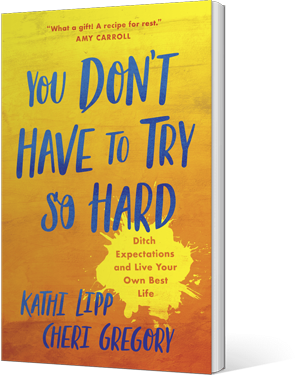
The book is, “You Don’t Have to Try So Hard” by Kathi Lipp and Cheri Gregory, or by Cheri Gregory and Kathi Lipp—however you want to say it! The introduction is by our sweet friend Amy Carroll.
You have the opportunity to win this! Tell me in the comments what area of perfectionism are you battling with right now? or have you won the battle? That’s what I would love to hear. Share that with us and we’re going to enter you to win that “You Don’t Have to Try So Hard” gift set. I feel like this book is something special Cheri. I feel like we’ve given people a lot of freedom and a lot of tools to be able to live the life that is God’s design for them. It’s really exciting to me.
Cheri thanks for being on Clutter-Free-Academy
Cheri:
Thanks for having me! It’s been a pleasure.
Kathi:
You guys have hung out with us for four weeks. I mean, if this isn’t enough Cheri and Kathi, I don’t know what to do for you! Thank you so much.
Get the download of the three most important things you need to know if you are a procrastinator, struggle with performancism or people pleasing, and the three most important things to know if you’re dealing with one of those people. We’re giving you the keys to the kingdom!
You’ve been listening to Clutter-Free-Academy. I’m Kathi Lipp. Now go create the clutter free life you were always intended to live.